 Timebook
 A Habit Tracker That Reads Your Day
Timebook has habits — you create one, set a target, watch the streak. What it never asks for is the daily check-in: the verdict is read off the day you already logged, and the check stays for the habits no record can judge.
What is a time-tracking habit tracker?
A habit tracker whose daily verdict is read off your log instead of filed by you. Timebook has habits — you create one, pick how many days you are committing to, and watch the streak, the same as in any habit app. What it never asks for is the check-in.
It is not the cheaper road, and that is worth saying before anything else: a checkbox is one tap a day, and a tracked activity is a start and a stop — one tap per switch once you are tracking continuously, since the next start closes the entry before it, but a cost the checkbox never charges. You pay it first. Everything below is about what it buys.
The habit layer is a real layer, not a reading of the timeline. A habit is an explicit commitment with a length you choose — a week, or a hundred days — a day counter, a streak, and a grid of the days that have and haven’t counted. One thing works differently: the habit is bound to an activity or a moment, and the day’s entries for that binding are what settle the verdict. Record-backed habit tracking is the name for that arrangement: the habit is a rule over your log, and the rule decides whether the day counts.
Why derive a habit’s verdict from your time log?
Because the two questions read the same record twice. Where did my time go and did I hold this commitment are answered from the same entries — so once the day is logged, the second answer is already sitting inside it.
That is what makes the input cost recoverable. The taps are spent once and collected several times: by the timeline, by the day’s totals, and by every habit whose binding covers that activity — a habit set on a whole category reads the same session as one set on the activity itself. A check filed for a habit is collected exactly once, by the habit that asked for it, and nothing else can read it afterwards.
It also changes who is reporting to whom. A check-in is a claim you file whenever you remember; a derived verdict is the app reading what you already wrote down, at the moment it becomes true.
What can a log tell you that a check can’t?
Four things a stored yes has no way to hold: how much, when, how far along you are right now, and what else that same record answers.
| Checkbox | Time log | |
|---|---|---|
| Taps per day | 1 | 2 — one per switch while tracking |
| What is stored | your answer | what happened, with times |
| Grain | done / not done | minutes, counts, timestamps |
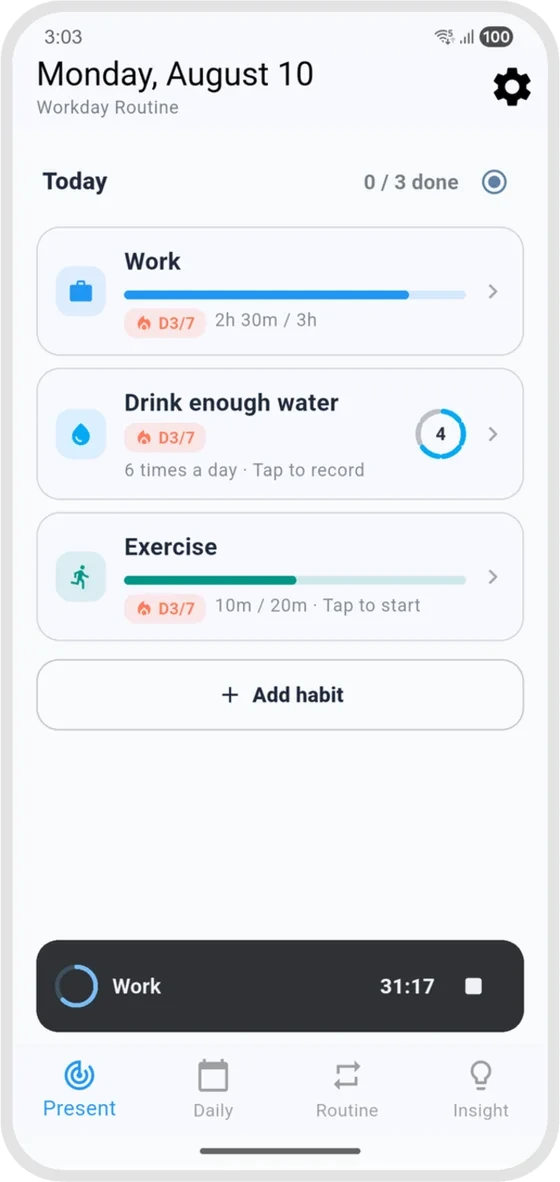
| Mid-day state | nothing until you check | 2h 30m of 3h, as it accrues |
| Getting it wrong | re-answer the day | fix the record, verdicts re-derive |
| Other uses | none — it answers one habit | timeline, day totals, other habits |
The last row is the one that compounds. A checked box is a dead end: it exists to answer the habit that created it, and nothing else can read it. A logged session is read by the timeline, by the day’s totals, and by every habit bound to that activity — the taps are spent once and collected several times.
How does a habit rule read the log?
By binding the habit to an activity or a moment it can measure. Timebook currently supports three common rule shapes:
“Read 20 minutes a day”
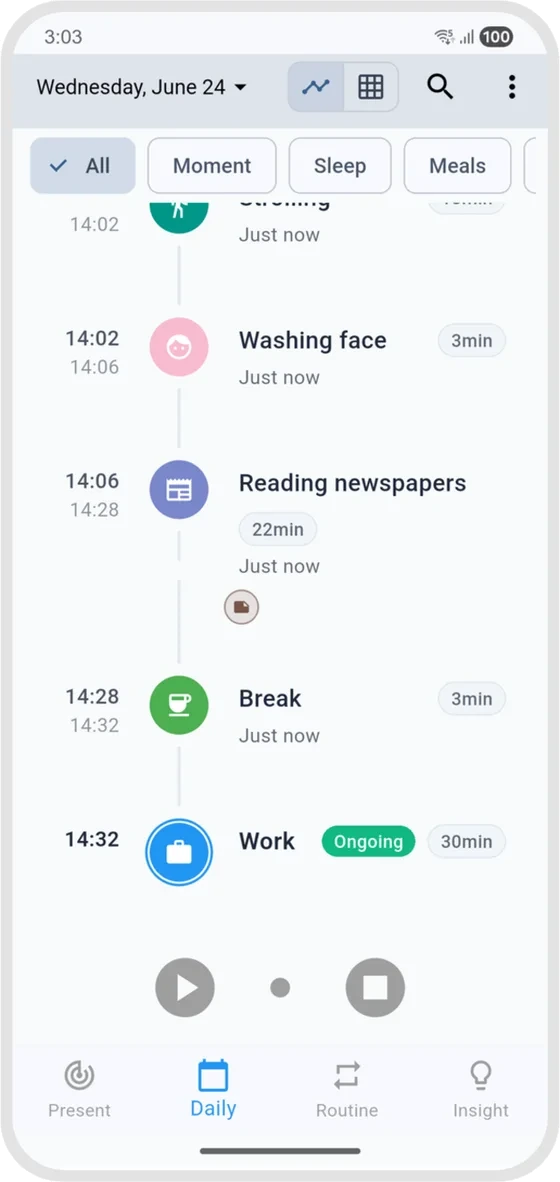
Sums the day’s reading sessions, so a chapter on the commute plus a chapter at bedtime is one reading day. A session that is still running counts its elapsed time, so the day flips the moment it is earned rather than after you remember to stop.
“Drink water” — 6× a day
Counts logged glasses — six by default, because the number is a logging target, not a health claim. Every glass has to be tapped in, and a higher target just means one forgotten tap breaks the day.
“Up early” — by 06:00
Reads the timestamp on your Get up moment: up by 06:00, judged with a grace window, so 06:28 counts.
Sleep, exercise, work, study and reading are all time totals. Habits like water or meals are counts. Wake-up and bedtime are timestamps. Some habits need no criterion at all — one record on the day is enough.
Why is deriving a verdict harder than storing one?
Because a rule that reads records runs into cases a checkbox never encounters, and the obvious version of the rule gets them wrong. Three of Timebook’s rules exist in their current form for that reason.
Bedtime is judged on a night arc, not a clock reading
“In bed by 23:00” compared as a plain minute-of-day would read a 00:30 turn-in as earlier than the deadline and pass it. So the rule runs along the circular arc of the night, and 00:30 reads as the late night it was.
A night of sleep counts for the morning it ended on
“Did I sleep enough” is a question you answer when you wake up, which is also the day “up early” is judged on — so a bundle of the two is judged on one night instead of two days apart.
For abstinence, evidence can only disqualify
An empty day cannot prove you didn’t drink — it might mean you drank and didn’t log it, and a rule that reads emptiness as success hands a perfect streak to someone who simply doesn’t track. So a logged lapse fails the day outright, and every other day waits for your own check. A record can break a day here; it can never make one.
Which habits stay manual?
The ones whose quality is invisible to a log. “Eat well” is the clearest case: the only thing it could bind to is a meal record, and a meal record says that you ate, not how you ate — so the verdict would pass on days the habit wasn’t kept.
Timebook leaves that habit unbound on purpose, and your own check decides the day. That is not an exception carved out of the design; it is the same habit layer taking its other input. Every habit has two — the rule reading the log, and you saying so — and your word wins wherever the two disagree, everywhere but the one case above: a logged lapse outranks the check that would erase it. On a habit with nothing to read, it is simply the only input that ever fires.
The checkbox is not the enemy of this design; it is the correct instrument where there is no evidence to read. Deriving where derivation is honest is the point, not deriving everywhere.
Can a derived verdict be wrong?
Yes, in both directions, and the reason is the same in each: the verdict is exactly as good as the log it reads.
It can miss what you did
Exercise you never logged does not exist as far as the rule is concerned, so the day derives to not-done.
It can credit what you didn’t do
A duration habit counts a still-running session’s elapsed time, so a timer you forgot to stop keeps accumulating minutes you weren’t spending — long enough, and the day reads as done. A mistyped start time or a session logged on the wrong activity does the same thing.
There is a backstop rather than a fix: an activity left running is auto-stopped at 24 hours, and an entry left open when the next one starts is closed at that start.
Both cases have the same repair — and it is the repair a stored answer cannot offer. Fix the record: add the session you missed, correct the time you mistyped. Because the verdict is recomputed on every read, the affected days re-derive immediately, including days months back. Or set a day by hand, and that explicit verdict is stored rather than derived, so a later incidental edit will not quietly undo it.
None of this supplies the intent. It removes the job of certifying what you already did; it does not do the thing for you.
Is the extra tap worth it for you?
It turns on one thing: whether you want the day’s record for its own sake. If you do, the habit verdicts are a by-product of something you were keeping anyway. If all you want is a streak, a checkbox costs one tap and does that job.
The honest version of the trade: you take on tracking your day, and you get back a record that answers questions you haven’t asked yet — including the one a habit rule asks on your behalf every time you open the app.
Questions people ask first
Isn’t a checkbox less work?
For a single habit, yes — one tap a day against a start and a stop. It costs less than that once the day is running: starting the next activity closes the previous one at the same instant, so continuous tracking is one tap per switch, and a moment — Get up, a glass of water — is a single tap, the same as a check. What you give up is grain and recourse: a check cannot say how long, when, or how far along you are, and there is nothing underneath it to correct.
Is a habit tracker the same as a time tracker?
No. A time tracker answers where did my time go. A habit tracker answers did I hold this commitment. Record-backed habit tracking connects them: the time log becomes the evidence the verdict is derived from.
Do I still have to check habits off every day?
Not for habits bound to something measurable — those are decided by your log. Habits that leave no usable trace stay manual, by design.
Does an automatic verdict overwrite what I say?
No. Your explicit check or un-check is stored and wins, with one exception: a day with a logged lapse on an abstinence habit stays a miss, and the way to change it is to fix the record.